The Hidden Costs of Re-Quoting Every Design Change

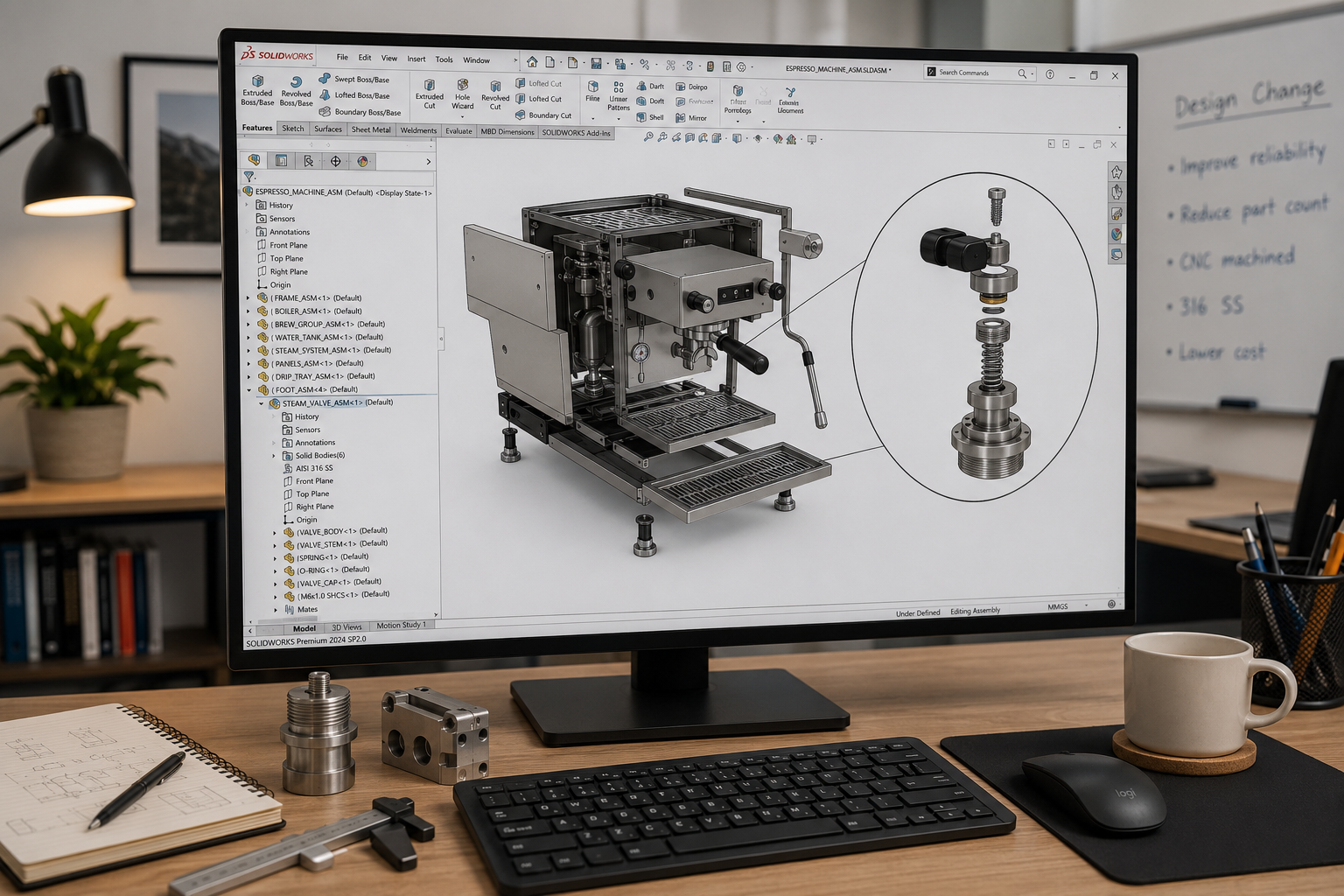
Design changes are going to happen. That’s not a problem to solve, it’s just part of building a product. You make a change, you learn something, you make another one. Teams that embrace that cycle build better products than teams that try to avoid it.
But there’s a real cost hiding inside that cycle, and it’s not the design work itself. It’s the quote.
Slow quotes slow down innovation. If every change has to wait days for a new number before you can move forward, you start to think twice about making changes you’d otherwise make. Slow quotes also slow down validation, because you can’t confirm a change worked until you see the cost or manufacturability behind it. And slow validation means a slow launch, because none of it moves until the last change clears.
What actually happens when a design changes
A design change doesn’t just get a new price stuck on it. The shop has to look at the part again from scratch. New tolerances change what tooling and fixturing is needed. New features can mean a different process altogether. Someone has to walk through the print, figure out what changed, and figure out what that means for machining time, setup, and cost.
That takes real time. A few days is normal. On a busy shop, or a part with a few changes stacked together, it can take longer. This isn’t the shop being slow. It’s just what re-quoting actually requires.
What that does to your schedule
Every design change resets the clock. You can’t move forward, order material, schedule a build, or greenlight the next stage, until you have the new number. So you wait.
One change costing you three or four days doesn’t feel like much. But design changes rarely happen once. String a handful of them together across a project and you’ve lost weeks, without anyone making a bad decision at any point along the way.
Design changes aren’t the exception, they’re the job
It’s easy to talk about design changes like they’re a sign something went wrong. They’re not. Most projects go through revisions constantly, from the first prototype all the way through to production. You genuinely can’t know if a design is right until you build it and test it. Then you learn something, you adjust, and you go again.
That’s not a broken process. That’s engineering. The problem isn’t that changes happen, it’s how much time each one costs to work through.
The part that makes this harder: sometimes the quote is the only way to know if the change worked
Most design changes need a new quote because the cost or manufacturability actually changed, and you need the new number to plan around. That part is obvious.
But there’s a second kind of change that’s easy to miss. Sometimes you change a design specifically to bring the cost down, or to make the part easier to manufacture. In that case, you don’t know if the change actually worked until you see the new quote. The quote isn’t just confirming what changed. It’s telling you whether the change did what you meant it to do.
That means for these changes, you can’t skip the quote or treat it as a formality. It’s the only signal you have.
The full loop, start to finish
Put it together and here’s what actually has to happen for a single design change meant to improve cost or manufacturability:
- Make the change to the design
- Build a prototype to validate form, fit, and function
- Get it quoted to see if it’s actually cheaper or easier to build
Three steps. Three separate turnarounds. Often three different people or vendors involved at each step. That’s how something that started as a small edit turns into a multi-week detour.
Why this adds up to so much
A typical project goes through this loop more than once. Multiply a few weeks per loop across a normal number of design iterations, and it starts to explain why prototype to production takes 12 to 18 months, even when the actual design work isn’t that complicated. The bottleneck usually isn’t the engineering. It’s how much time gets burned waiting for the manufacturing side to catch up with each change.
Why we built OpusFab
This is close to the reason OpusFab exists. The design changes were never the problem. The wait between making a change and knowing what it actually costs was.
If you’re tired of waiting on quotes to find out if a design change worked, register for OpusFab and start getting instant quotes.