The Right Way to Prototype Your Product
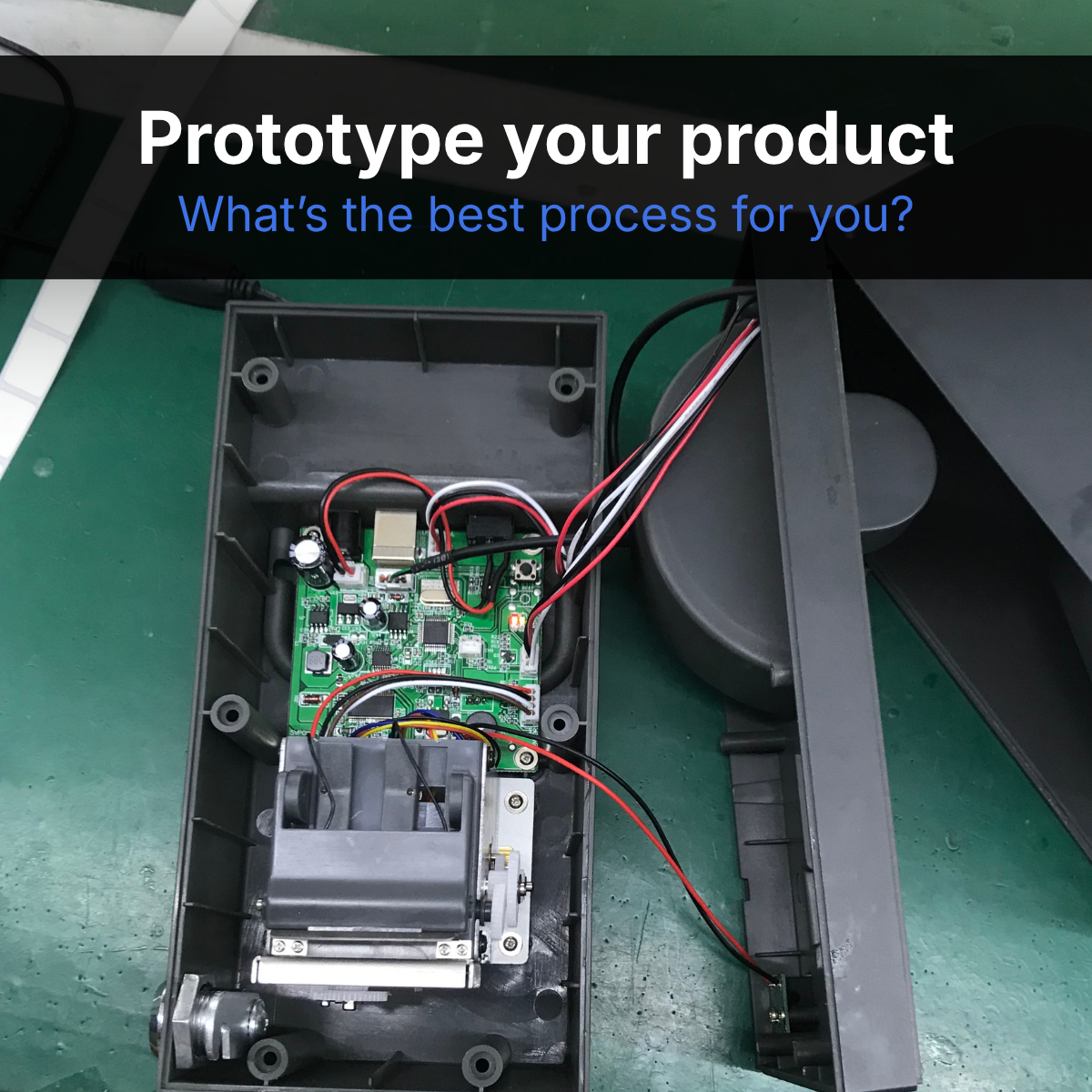
Making prototypes is a necessary part of getting a product into production. Teams consistently underestimate both the cost and the number of rounds required to validate a design, and this is where most of the frustration in the process comes from.
There is no single correct process for every product. Depending on the industry and the part, what works well for one team may not work for another. The patterns below are common across many manufacturing processes, though the details vary by product and industry.
What is wrong with the traditional prototyping process
A few issues show up repeatedly across teams building physical products, regardless of industry. Some are structural, tied to how prototyping work is organized and staffed. Others are procedural, tied to decisions made earlier in the design process that create problems later. Together, they explain most of the cost overruns and delays that teams run into when prototyping.
1. Finding the balance between automation and hands-on support
Some parts of the prototyping process can be automated, and in most cases they should be. Quoting, part status tracking, and an initial pass at design feedback are all tasks that do not require a person to handle manually every time. Automating them reduces turnaround time and removes a lot of the administrative overhead that slows projects down.
At the same time, prototyping is not a process that can be fully automated. New designs come with open questions, tolerances that need to be checked by hand, and fixture or setup decisions that require judgment. This work still depends on direct engineering or project management attention. Many companies default to one extreme or the other. They either try to run prototyping the same way they run production, with minimal oversight, or they keep everything manual, including tasks that add no real value being done by hand. Few have built a process that automates the repetitive parts while keeping engineering attention on the parts that actually need it.
2. Underestimating the number of builds required
Design validation almost always takes more rounds than the initial plan accounts for. A team might plan for three builds, budget and schedule accordingly, and then find that getting the design to a production ready state actually took six or seven rounds.
This has a compounding effect rather than a simple additive one. Each additional build adds direct cost, but it also pushes the schedule out, which in turn delays every downstream milestone tied to that timeline, including tooling, supplier onboarding, and launch date. A plan built around an optimistic number of prototype rounds tends to be wrong on both cost and time at the same point, which is part of why this issue is so disruptive when it shows up.
3. Data is not always clear across the team
Design changes are constant during development. A revision made in one part of the design often affects tolerances, materials, or assembly steps elsewhere, and that information does not always make it to everyone who needs it. Internal teams may be working from different versions of a file. Suppliers may be quoting or building against a spec that is a few revisions old.
When this happens, the result is usually a part that does not match the current design intent. That part still has to be caught, diagnosed, and rebuilt, which adds a delay that was never part of the original plan. Over the course of a project, this kind of miscommunication is one of the more preventable sources of wasted prototype rounds, since the underlying issue is rarely the manufacturing process itself but the way information about it was communicated.
4. Pushing off DFM feedback
Not every prototype needs to be built with production in mind. In some cases, the only goal is to validate that a design concept functions as intended, and that is a reasonable and often necessary step on its own.
The issue arises when manufacturability is never checked before the project moves further along. If a concept is validated, and the team invests further time and budget assuming the design is close to final, only to discover manufacturability issues once production is in view, the earlier validation work does not carry the value it was expected to. A design for manufacturability (DFM) review earlier in the process, even a lightweight one, surfaces these issues while they are still cheap to fix, rather than after tooling or supplier commitments have already been made.
5. Not getting a mass production quote
A related issue is cost. During prototyping, the focus is usually on whether the design works, not on what it will cost to produce at volume. That is a reasonable prioritization in the early stages of a project.
The problem is that this can go on for too long. If a design is fully validated and then turns out to be well outside the target production cost once quoted, the time spent validating that design produced limited practical value, since the design now has to be reworked anyway. Getting even a rough, high level production quote earlier in the process gives a team a cost target to design against, rather than discovering the mismatch after the design is already considered final.
What OpusFab does
Every industry, and often every company within an industry, has its own way of approaching prototyping. There is no universal process that fits every product, material, or production volume. OpusFab was built based on patterns I observed directly over more than a decade running contract manufacturing operations, not as a theoretical framework, but as a response to the specific issues described above.
Technology can meaningfully improve speed and consistency in this process, but prototyping still depends on a level of judgment and hands-on attention that only comes from engineers and project managers who are directly involved in the work. OpusFab is built around that combination. The platform automates the tasks that do not need a person doing them manually every time, including quoting and an initial round of design feedback, which frees up the team to spend its attention on the parts of a project that actually require direct engineering involvement.
Customers can work independently through the platform for most of the process. A STEP file, 2D drawings, and any other supporting documentation can be uploaded directly. Materials and finishes are defined as part of the same workflow. A quote is generated across multiple quantity tiers, giving visibility into how cost changes with volume, and the order is placed directly from there.
If a design has potential manufacturability issues, those are identified and communicated before purchase, not after the order has already been placed. The platform also flags alternative manufacturing processes when a more cost effective or better suited option is available for a given part.
Once an order is placed, customers get live status updates, so they always know exactly where a part is in the manufacturing process without having to follow up to ask.
Together, this removes several of the most common points of friction in prototyping: waiting on a quote, uncertainty about whether a design is actually manufacturable, and a lack of visibility into order status. Pricing is also fixed at the time of purchase and does not change afterward.
When a project needs more than the self-serve workflow can provide, OpusFab also has a team of engineers and project managers who work directly with customers on more complex or higher touch projects.
Summary
Prototyping will generally require more attention and more rounds of iteration than most teams initially plan for. The difference between a workable process and a difficult one usually comes down to whether that process is transparent and predictable, or slow and prone to surprises late in the project. More information is available at opusfab.com.