Why Fast Manufacturing Quotes No Longer Means a Supplier Is Cutting Corners
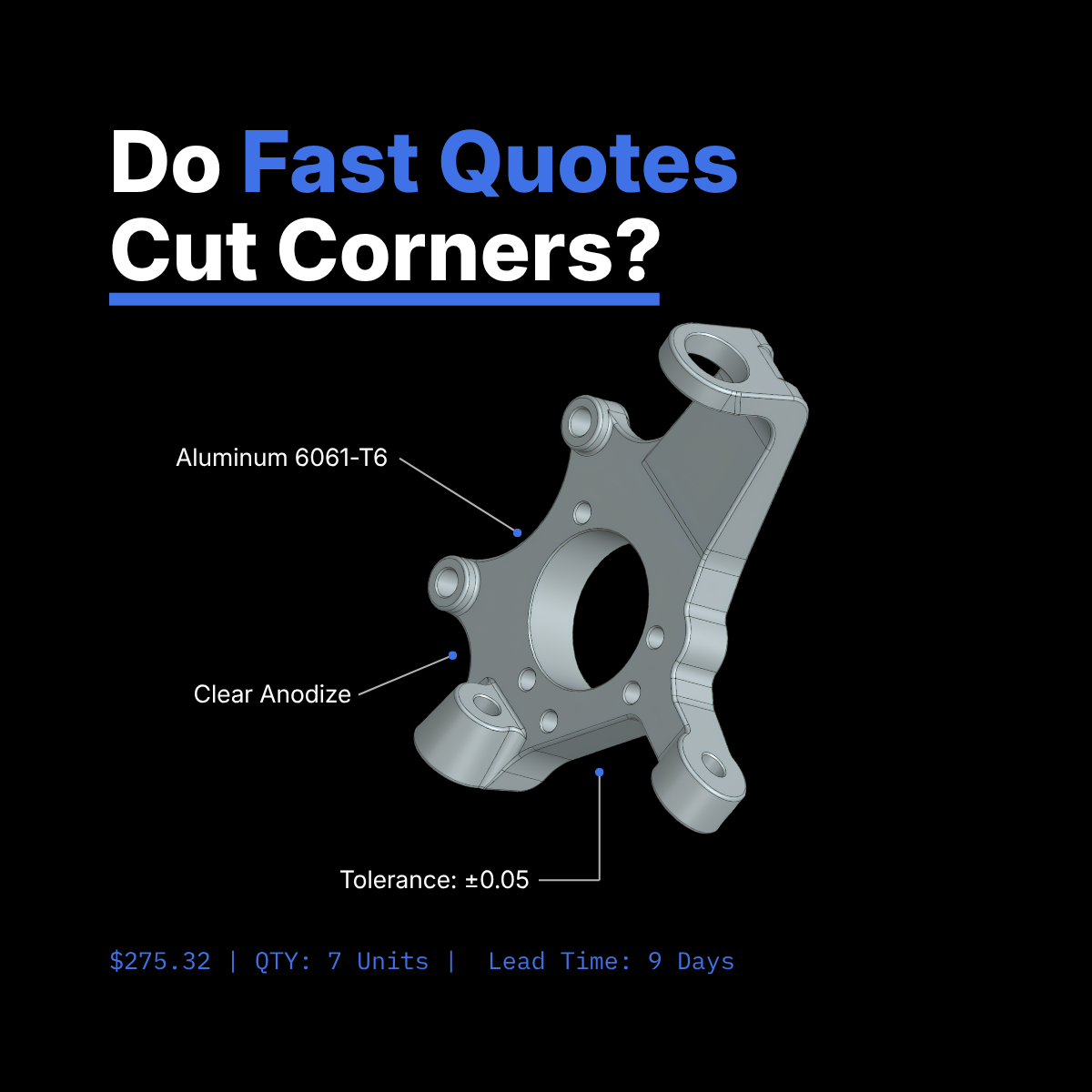

A quote that came back quickly used to be a warning sign. If a supplier hadn’t taken the time to review a drawing, check tolerances, or ask about finish, a fast turnaround usually meant they hadn’t actually looked at the part. Speed and diligence were treated as opposites, because generating an accurate quote required a person to sit down with the file and work through it manually.
That assumption no longer holds. As manufacturing platforms have built up more production data, a quote can be generated in seconds and still reflect the same considerations an experienced engineer would apply by hand. Getting there means understanding what made the old process slow in the first place, and what an instant quote actually needs to work.
The Traditional RFQ Process
A traditional RFQ starts with a customer sending a drawing or model to one or more suppliers, then waiting. An engineer reviews the file, checks the geometry against the shop’s process capabilities, and works out material cost, machine time, setup, and finishing. If anything is unclear, the engineer or account manager emails the customer back with questions and waits for a reply before finishing the number. Depending on the shop’s queue and how many rounds of questions it takes, this can run anywhere from a few days to over a week for a single part.
The tradeoff held because quoting was a manual process. Every quote depends on someone’s judgement and this analysis takes time. A shop that returned a number in an hour either hadn’t reviewed the file closely or was quoting from a rough estimate rather than a real one. But this is now changing.
Welcome Instant Manufacturing Quotes
The shift to instant manufacturing quotes is enabled by collecting data and setting rules and logic. A quoting engine trained on thousands of previously manufactured parts can recognize geometry, material behavior, and cost drivers that used to require manual review. It has seen similar parts before, knows what they cost to make, and knows what tends to go wrong. That is a different kind of speed than skipping steps. It’s pattern matching against real production history rather than guessing.
This is also why the quote is only as good as the data behind it. A system trained on a narrow or shallow dataset will produce a fast number that means very little. One trained on years of real production runs, across a wide range of parts and processes, can produce a fast number that holds up.
Another benefit of instant quotes is that it usually is done hand in hand with a design for manufacturing (DFM) report. Nobody wants to make parts that are not optimized, and now that check is built into the quote instead of coming as an afterthought.
The Quote Is Only as Good as the Information It’s Given
Even with a strong data foundation, an instant quote still depends on the data that is provided. A quoting engine can infer a lot from geometry, but it can’t infer intent. If a spec is left out, the system either has to guess or flag it, and neither of those is as good as simply providing the information up front.
The details that matter most for accuracy are usually specific and easy to overlook:
- Material — not just “aluminum,” but the specific alloy and temper, since cost and machinability vary significantly across grades
- Finish — bead blast, anodize, powder coat, or as-machined all carry different costs and lead times
- Color — relevant for anodizing, powder coating, or other finishes
- Quantity — pricing per unit changes with volume, and setup costs get amortized differently at 1 part versus 100
- Threads — tapped holes, heli-coils, or thread inserts all require different processing
- Logos or engravings — these add a secondary operation that a bare 3D model won’t show
None of these are exotic requirements. They’re the same details a human quoting engineer would ask about before finalizing a number. The difference is that an instant quoting system needs them supplied up front, since there’s no back-and-forth email exchange to fill the gaps.
What Happens When Information Is Missing
When a spec isn’t provided, one of two things happens. The system makes an assumption, which is only correct by chance, or it flags the gap and the quote gets delayed until someone answers a question. Both outcomes defeat the purpose of an instant quote. The whole point is to remove the back-and-forth, not just delay it until after the number is generated.
This is why the most useful thing an engineering team can do to get an accurate quote quickly is upload a complete file with the specs called out precisely, rather than leaving decisions up to the supplier’s interpretation. A part with a fully defined material, finish, and quantity will get a quote that reflects the real cost. A part with those details missing will get a placeholder number that has to be corrected later, which is slower than if it had been specified correctly the first time.
Speed and Accuracy Aren’t Opposites Anymore
The old logic, that a fast quote meant a supplier hadn’t done the work, made sense when every quote was generated by hand. It doesn’t hold anymore. A quoting engine built on real production data can return an accurate number quickly, provided it has the same information a person would have needed to do the job manually.
The speed comes from the system. The accuracy still comes from the input. Getting both means giving the quoting engine everything it needs the first time, not treating the details as optional.
If you are looking for instant manufacturing quotes then register to OpusFab.